Email:info@softosmith.com
Working Hours:Mon - Fri: 9 AM - 5 PM (PKT)
When stock Odoo apps don't cover your process, we build custom models, business logic, and OWL frontend components against Odoo's own architecture — upgrade-safe, for Odoo 17 through 19.
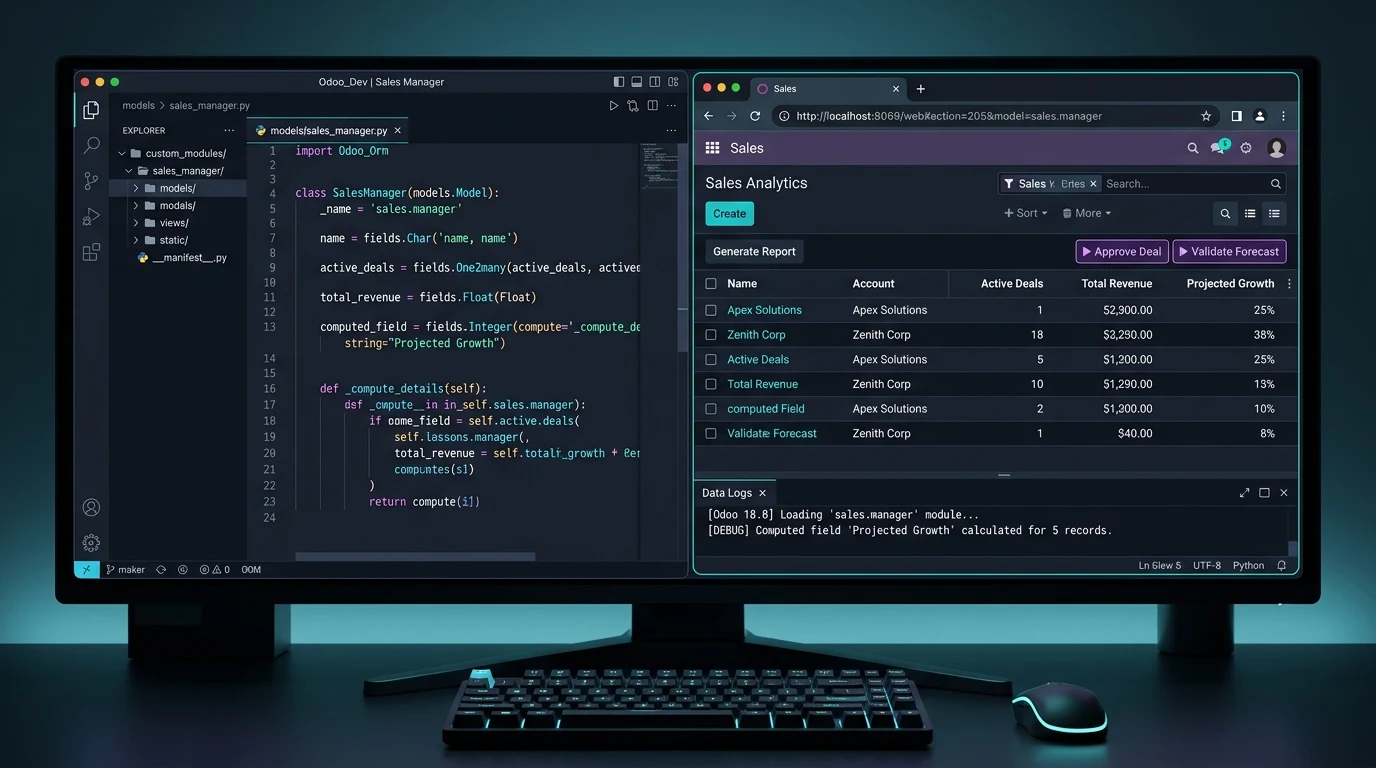
Configuration only goes so far. Once your workflow needs data or logic Odoo doesn't ship with, you're stuck patching around it — or paying for an App Store add-on that's a rough fit and unmaintained.
Your process needs a data field, calculation, or approval step that no stock app supports.
In-house tweaks made directly to Odoo core files, breaking on the next version upgrade.
An App Store module that's close enough but hasn't been updated in years, with no support to speak of.
We write custom models and business logic against Odoo's ORM, build OWL frontend components when the UI needs something stock views can't do, and configure XML views and security rules so the module respects Odoo's own permission model — all upgrade-safe by construction.
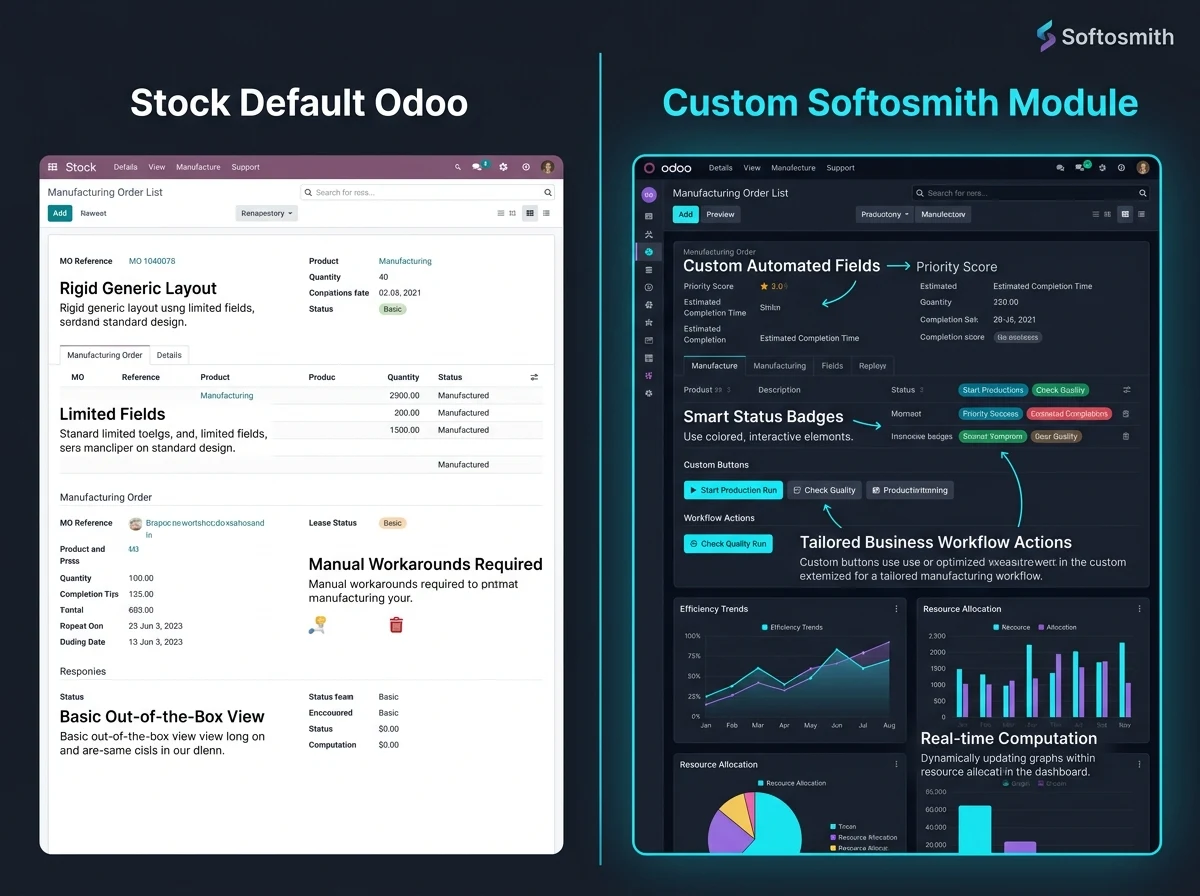
Everything needed to close the gap between stock Odoo and how your business actually operates.
New Odoo models, computed fields, and Python business logic written against the ORM for the exact process stock apps don't cover.
Interactive UI built with Odoo's own OWL framework, so custom screens feel native instead of bolted on.
Form, list, and kanban views extended through proper view inheritance instead of overwriting Odoo core.
Record rules and access control lists configured per group, so custom modules respect the same security model as Odoo core.
Scheduled actions, automated workflows, and server-side logic that trigger on the events your process actually needs.
QWeb report templates for invoices, delivery slips, and custom documents styled to match your business.
Google Preferred Source is a free Odoo 19 module we built and published on the official Odoo Apps Store — it adds Google's Preferred Sources badge to any Odoo website to boost visibility in Search and AI Overviews. It's a small, public example of the same module architecture we use on every custom build.
Real Odoo module development means working with Odoo's actual architecture, not fighting it with core edits and CSS hacks.
Custom models, computed fields, constraints, and business logic written against Odoo's ORM, not raw SQL hacks that break on upgrade.
Frontend components built with Odoo's own OWL framework and QWeb templating, so custom UI stays native to Odoo instead of feeling bolted on.
Proper view inheritance, access rights, and record rules, so custom features respect the same security model as Odoo core.
Schema design and query optimization on PostgreSQL, the database Odoo is actually built on, for modules that stay fast at scale.
We don't just build internal modules — we've shipped and maintain a published, open-source Odoo app, so we know what App Store review actually checks for.
A clear, six-step process from requirements to ongoing support.
We document the exact process the module needs to support, including edge cases stock apps don't handle.
Models, views, security rules, and integration points mapped out and approved before any code is written.
The module built against Odoo's ORM and OWL framework, version-controlled in Git from the first commit.
The module tested against your actual records and workflows, not just sample data.
Installed on your Odoo.sh or on-premise instance with a staged rollout.
Ongoing support for Odoo version upgrades and adjustments as your process evolves.
Custom MRP logic and work order modules built around your actual production floor.
Custom checkout logic, POS extensions, and inventory sync modules across channels.
Custom project, timesheet, and invoicing modules matched to how your team bills and delivers.
Custom enrollment and course-sync modules connecting Odoo to systems like Moodle.
Custom appointment and compliance-aware modules for regulated healthcare operations.
Custom property, lead, and contract modules built around your sales and leasing process.
No client logos or star ratings here — just the commitments every module build is held to.
You work directly with the engineer building your module — no account managers relaying messages back and forth.
The quote we give you upfront is what you pay. No surprise invoices once development starts.
Not just internal work — we've built and published a free, open-source Odoo app on the official Odoo Apps Store, so it's live for you to inspect before you hire us.
Your module's source code, on your Odoo instance. Nothing rented, nothing locked behind us after handover.
You know exactly where your build stands at every stage, from spec through deployment — no radio silence.
A post-launch support window is built into every engagement, so a broken module after an Odoo upgrade doesn't become your problem alone.
Fixed-scope pricing to start — final quotes depend on the models and integrations involved. Need something bigger? Contact us for an Enterprise quote.
$3,000 starting
One custom module or workflow customization, scoped and built.
$6,500 starting
Multiple connected custom modules built as one cohesive system.
Straight answers to what clients usually ask before starting a build.
When your process needs new data, logic, or screens that don't exist in stock Odoo — not just different settings. For straightforward app rollouts and configuration, see our Odoo implementation services instead.
We build on Odoo 17 through 19, including Community, Enterprise, and Odoo.sh. Our published Google Preferred Source app runs on Odoo 19.
Yes. We built and published Google Preferred Source, a free, open-source Odoo 19 module on the official Odoo Apps Store — you can inspect the code yourself before hiring us.
No. Odoo Online restricts custom module installation. Custom modules need Odoo.sh or an on-premise instance — we'll flag this early if it affects your hosting plan.
Not if it's built the way we build it — using Odoo's own ORM, view inheritance, and module structure instead of direct core edits. We also test module compatibility against new Odoo releases.
You do, fully. The module's source code lives on your Odoo instance — nothing is rented or locked behind an ongoing license with us.
A single, well-scoped module typically takes 2 to 4 weeks. A suite of connected modules usually runs 6 to 8 weeks, depending on how many models and integrations are involved.
Yes, where it matters — business logic that affects financial or inventory data gets test coverage as part of the build, not left for you to discover in production.
Tell us about your process and we'll scope a custom module around it.
Get a Free Odoo Quote
