Email:info@softosmith.com
Working Hours:Mon - Fri: 9 AM - 5 PM (PKT)
We build custom integrations against Odoo's REST and XML-RPC APIs — payment gateways, WhatsApp, shipping carriers, and internal systems — so Odoo isn't an island in your stack, for Odoo 17 through 19.
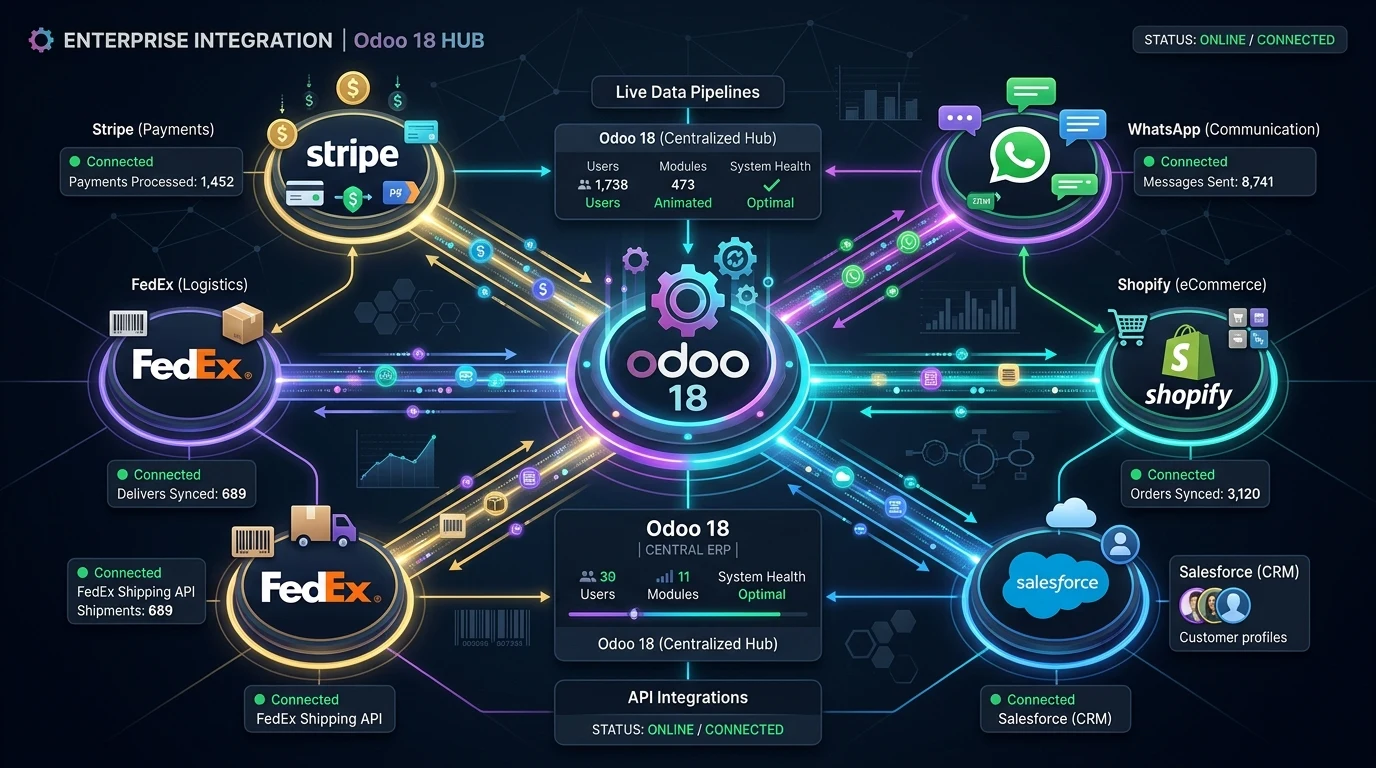
Odoo handles a lot on its own, but most businesses still run payment gateways, messaging tools, and shipping carriers outside it — and every disconnected system means someone re-entering the same data by hand.
Orders, payments, or messages copied by hand between Odoo and the tool that actually handles them.
Batch jobs that run once a day, so Odoo's data is always a step behind what's actually happening.
The App Store integration that's close but doesn't sync the specific fields or events your process needs.
We connect Odoo to your other systems through its REST and XML-RPC APIs and webhooks, handling authentication, data mapping, and error handling properly — so data flows automatically instead of being copied by hand.
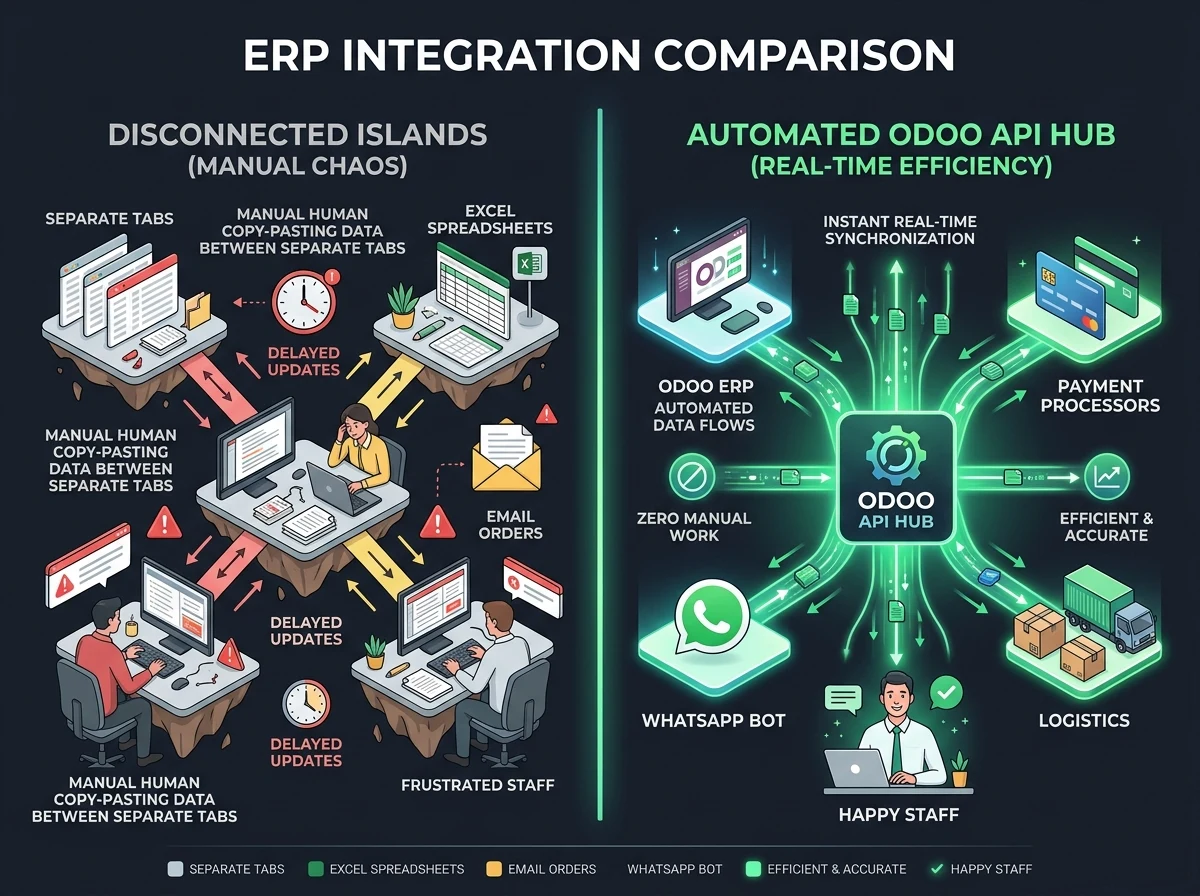
Everything needed to stop treating Odoo as a separate system from the tools you actually run your business on.
Custom integrations built against Odoo's REST and XML-RPC APIs, so external systems can read and write Odoo data reliably.
Real-time sync triggered by Odoo events, so data updates flow out the moment they happen instead of on a delayed batch job.
Payment providers connected directly into Odoo's Sales and Invoicing apps, so transactions reconcile without manual entry.
WhatsApp and other messaging channels connected to CRM and Sales, so conversations and order updates stay in one place.
Shipping carriers connected into Inventory and Sales, so rates, labels, and tracking sync directly without a separate portal.
Custom connectors to marketing tools, accounting software, or internal systems that don't have an off-the-shelf Odoo integration.
Google Preferred Source is a free Odoo 19 module we built and published on the official Odoo Apps Store — it adds Google's Preferred Sources badge to any Odoo website to boost visibility in Search and AI Overviews. It's a small, public example of the same production-grade code quality we bring to every integration.
Real Odoo integration work means working with Odoo's actual APIs correctly, not fragile scraping or one-off scripts.
Custom integrations built against Odoo's own external APIs, reading and writing data the way Odoo expects, not through fragile scraping.
Odoo automated actions and server actions wired to fire webhooks or process incoming ones on the events that actually matter.
Sync logic and data transformation written against Odoo's ORM, so integrated data respects the same validation rules as manual entry.
OAuth and API key handling done properly, so integrations don't leak credentials or expose more than the third-party tool needs.
We've shipped and maintain a published, open-source Odoo app, so we know what production-grade Odoo integration code actually looks like.
A clear, six-step process from audit to ongoing support.
We review the third-party system's API, the data that needs to sync, and how often it needs to update.
Data mapping, sync direction, and error handling mapped out and approved before any code is written.
The integration built against Odoo's APIs and the third-party system's, version-controlled in Git.
The sync tested against real records on both sides, including edge cases like failed syncs and duplicate records.
Rolled out on your Odoo.sh or on-premise instance with monitoring for sync failures.
Ongoing support as the third-party API or your Odoo version changes.
Integrations connecting Odoo Inventory and MRP to supplier and logistics systems.
Payment gateways, shipping carriers, and marketplace integrations connected to Sales and Inventory.
Integrations connecting Odoo Invoicing to payment processors and client communication tools.
Odoo CRM connected to enrollment and course systems, including Moodle, via custom API integrations.
Secure integrations connecting Odoo to scheduling and compliance-aware systems.
CRM integrations connecting Odoo to listing portals and communication tools.
No client logos or star ratings here — just the commitments every integration is held to.
You work directly with the engineer building your integration — no account managers relaying messages back and forth.
The quote we give you upfront is what you pay. No surprise invoices once development starts.
Not just internal work — we've built and published a free, open-source Odoo app on the official Odoo Apps Store, so it's live for you to inspect before you hire us.
Your integration's source code, on your Odoo instance. Nothing rented, nothing locked behind us after handover.
You know exactly where your integration stands at every stage, from audit through deployment — no radio silence.
A post-launch support window is built into every engagement, so a broken sync after a third-party API change doesn't become your problem alone.
Fixed-scope pricing to start — final quotes depend on the systems and data volume involved. Need something bigger? Contact us for an Enterprise quote.
$2,500 starting
One third-party tool connected to Odoo — payment gateway, messaging, or shipping.
$6,000 starting
Multiple systems connected to Odoo as one coordinated data flow.
Straight answers to what clients usually ask before starting an integration.
Payment gateways, WhatsApp and messaging platforms, shipping carriers, marketing tools, accounting software, and any other system with a REST, XML-RPC, or webhook-based API.
We build on Odoo 17 through 19, including Community, Enterprise, and Odoo.sh. Our published Google Preferred Source app runs on Odoo 19.
Yes. We built and published Google Preferred Source, a free, open-source Odoo 19 module on the official Odoo Apps Store — you can inspect the code yourself before hiring us.
Integrations that only use Odoo's external APIs can often work with Odoo Online, but anything requiring a custom module installed on the server needs Odoo.sh or on-premise. We'll flag which applies during the audit.
We monitor for sync failures during the support window, and ongoing support covers adjusting the integration if the third-party API changes after launch.
Yes. Authentication is handled through proper OAuth or API key management, and we never store more credentials or data than the integration actually needs.
A single integration typically takes 2 to 4 weeks. A multi-system integration usually runs 4 to 8 weeks, depending on how many systems and data flows are involved.
You do, fully. The integration's source code lives on your Odoo instance — nothing is rented or locked behind an ongoing license with us.
Tell us which systems you need connected and we'll scope an integration around it.
Get a Free Odoo Quote
