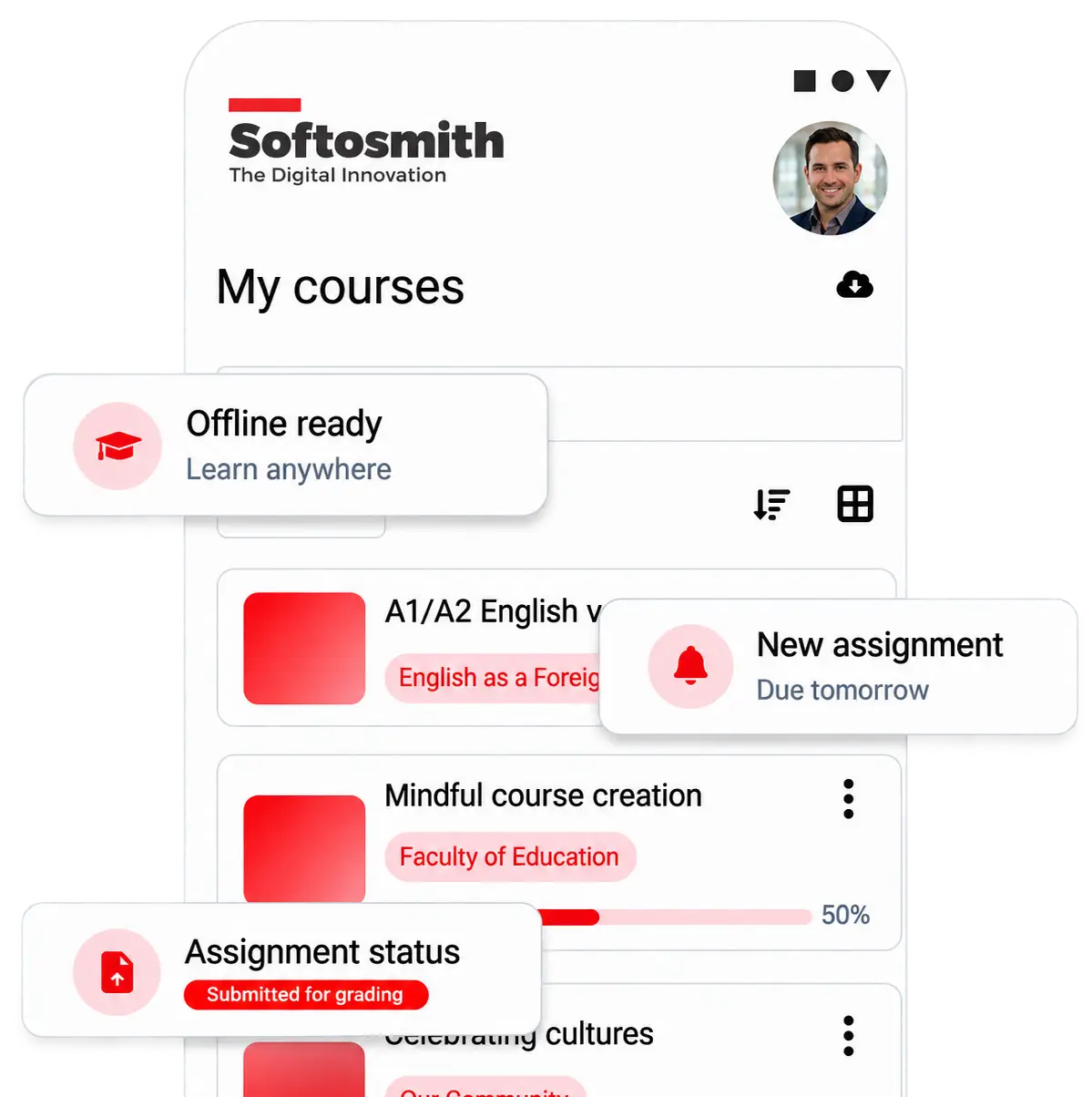
Moodle Mobile App Development & Airnotifier: The Definitive Guide to Custom Apps & Push Notifications in 2026

Key Insights & Technical Highlights
- Mobile-First Shift: 75%+ of active LMS learners access courses via smartphones; desktop web themes cause friction and dropouts.
- Architecture Choice: Compare white-labeling Moodle's official Ionic/Angular app vs. building a custom headless app (Flutter / React Native) with REST APIs.
- Offline Sync Engine: Pre-download SCORM/H5P packages, store encrypted data in SQLCipher local DB, and auto-sync offline quiz submissions.
- Airnotifier Push Infrastructure: Configure and self-host Airnotifier to bypass Moodle's 50-device free notification limit, connect Google FCM HTTP v1 and Apple APNs, and support end-to-end encrypted alerts.
- Enterprise Security: Implement TLS 1.3, SSL certificate pinning, video DRM protection, biometrics (Face ID/Touch ID), and SAML 2.0 / OAuth2 SSO.
- Custom API Extensions: Extend Moodle core backend using custom PHP web service plugins (
db/services.php) to expose proprietary data. - Direct Service Link: Need turn-key delivery? Explore our specialized Moodle Mobile App Development Services.
Over 75% of global learners now access educational content, quizzes, and course discussions on mobile devices. Yet, hundreds of universities, corporations, and government training organizations still rely on desktop-centric LMS interfaces. When forced onto mobile browsers, desktop-first interfaces create friction: broken layout scaling, high latency, missing offline access, and poor completion rates.
Moodle™ is the world’s most widely deployed open-source Learning Management System (LMS), powering over 350 million users worldwide. To deliver learning that fits modern habits, organizations are turning to Moodle mobile app development. Whether through white-labeling the official Moodle app, customizing the Ionic codebase, or engineering a bespoke headless mobile app in Flutter or React Native, mobile applications bridge the gap between institutional content and learner engagement.
1. The Mobile-First Learning Imperative
Modern mobile learners demand instantaneous load times, swipe gestures, native push notifications, and seamless offline accessibility during commutes or field operations. Organizations transitioning from browser-based LMS access to native mobile learning apps report:
- 45% Higher Course Completion Rates compared to desktop LMS portals.
- 3x Faster Progression through micro-learning modules (3–5 minute sessions).
- 90%+ Push Notification Open Rates for deadline alerts and grade releases compared to submerged email notifications.
2. Technical Architecture: How Moodle Mobile Applications Work
The mobile ecosystem for Moodle relies on a decoupled, client-server architecture where the mobile app communicates exclusively with the Moodle backend through dedicated Web Services API endpoints.
2.1 The Official Stack: Ionic, Angular & Capacitor
The standard Moodle Mobile application is an open-source cross-platform application built on:
- Ionic Framework & Angular: Ionic supplies touch-optimized UI components (cards, lists, modals) while Angular manages reactive state, dependency injection, and routing.
- Capacitor / Cordova Plugins: Native wrapper plugins provide direct hardware hooks into device APIs, including camera access, file system access, biometric hardware (Face ID / Touch ID), local push notifications, and network status monitoring.
- SQLite Local Database: A local database caches course structures, SCORM packages, quiz questions, and pending offline submissions.
2.2 The Web Services API Layer (moodle_mobile_app)
Moodle does not expose direct database connections to mobile devices. Instead, all communication flows through the core moodle_mobile_app web service plugin using REST/JSON endpoints for authentication, token issuance, course fetching, and assignment submissions.
3. Architecture Choice: Official Ionic Fork vs. Custom Headless App (Flutter / React Native)
When planning your mobile strategy, one of the most critical engineering decisions is choosing between forking/customizing the official Ionic app or building a custom headless mobile application from scratch.
| Criteria | Forking Moodle Ionic App | Custom Headless (Flutter / RN) | Progressive Web App (PWA) |
|---|---|---|---|
| Development Speed | Fast (2-4 weeks) | Moderate (8-14 weeks) | Very Fast (1-3 weeks) |
| UI/UX Customization | Moderate (CSS Tokens) | Unlimited (Custom Canvas) | Restricted to Webview |
| Performance (FPS) | Good (60 FPS Webview) | Exceptional (120 FPS Native) | Browser Dependent |
| Offline Sync Engine | Built-in (Moodle Core) | Must Build Custom Sync | Basic (Service Workers) |
| Best For | Universities & Schools | Enterprise L&D & EdTech SaaS | Short-term Events / MVP |
For organizations seeking a rapid, fully compliant deployment under their own App Store and Google Play accounts, working with professional Moodle mobile app development services guarantees smooth theme customisation, SSO authentication, and App Store submission management.
4. Offline-First Learning Engine: Download, Learn, Sync
In regions with spotty cellular networks, during commutes, or in field-based enterprise training (e.g., maritime, aviation, remote mining, healthcare), offline connectivity is a strict operational requirement.
4.1 Content Pre-Download & Local Caching
An enterprise Moodle mobile app allows learners to selectively download course materials:
- Selective Module Download: Download specific sections, videos, or assignments to manage device storage limits.
- H5P & SCORM Offline Execution: Pre-unpacking ZIP packages into local directory structures where embedded JavaScript runs within an offline web container, tracking scores locally.
- Conflict Resolution Rules: Implementing Last-Write-Wins (LWW) for draft assignments and Server Priority for updated quiz answer keys.
5. Enterprise Security, Compliance & DRM Protection
Deploying a mobile LMS application within enterprise or government environments demands rigorous security measures to protect intellectual property and student Personal Identifiable Information (PII).
- Local Database Encryption (SQLCipher): Applying AES-256 encryption to the entire local SQLite file, securing encryption keys inside iOS Keychain or Android KeyStore.
- Single Sign-On (SSO): Integration with enterprise identity providers including Microsoft Azure AD (Entra ID), Okta, Ping Identity, and SAML 2.0.
- Video DRM & Anti-Piracy Protection: HTTP Live Streaming (HLS) with AES-128 key rotation, native screenshot blocking (
FLAG_SECURE), and dynamic user watermarking.
6.Moodle Push Notifications & Airnotifier Architecture
Push notifications are the single most effective tool for driving course retention and learner engagement. Automated deadline reminders, grade publications, direct messages, and discussion forum mentions achieve an average 90%+ open rate on mobile devices—compared to less than 20% for automated LMS emails.
However, delivering push notifications in Moodle is technically distinct from standard web notifications. Moodle LMS cannot communicate directly with Apple Push Notification service (APNs) or Google Firebase Cloud Messaging (FCM). Instead, Moodle relies on an open-source notification gateway called Airnotifier.
6.1 The End-to-End Moodle Push Notification Pipeline
Every mobile push alert follows an eight-step pipeline across client devices, Moodle core, Airnotifier, and OS notification gateways:
- Device Token Acquisition: When a learner installs and opens your mobile app on iOS or Android, the app requests system notification permissions. The operating system registers with APNs or FCM and returns a unique, device-specific push token (the
pushid). - Web Service Device Registration: The mobile app invokes Moodle's core web service function
core_user_add_user_device. It transmits device attributes: user ID, platform (iosorandroid), device model, OS version, application ID, push token, and a persistent UUID. - Database Persistence: Moodle stores the registration inside the
mdl_user_devicestable. Each user can have multiple registered devices (e.g., an iPad and an Android smartphone). - LMS Event Trigger: A trigger event occurs in Moodle (such as an instructor publishing assignment feedback, a quiz deadline approaching, or a new forum post in an enrolled course).
- Message Processor Dispatch: Moodle's internal message processor evaluates active outputs. If
message_airnotifieris enabled and the recipient has active mobile devices inmdl_user_devices, a push payload is queued. - Outbound HTTP POST to Airnotifier: Moodle formats a JSON payload containing the notification subject, body, badge count, user metadata, and custom context parameters, then dispatches an authenticated HTTP POST request to the configured Airnotifier server URL (
/api/v2/push/). - Airnotifier Gateway Relay: Airnotifier inspects the targeted device platforms. It packages Apple payloads into HTTP/2 frames authenticated with APNs authentication keys, and packages Android payloads into OAuth2-authenticated Google FCM HTTP v1 JSON messages.
- Native Delivery & Deep Linking: The learner's device receives the push message, presents the banner alert, increments the app's badge counter, and upon tapping, deep-links the student directly to the relevant course module or assignment submission page.
6.2 The 50-Device Limitation on Hosted messages.moodle.net
By default, standard Moodle installations route push notifications through Moodle HQ's hosted messaging gateway at https://messages.moodle.net. While this provides zero-configuration setup for small trials, it introduces a severe operational bottleneck for growing organizations:
- Free Plan Limit: Moodle HQ caps free sites at 50 active registered devices per calendar month.
- Silent Failure: Once 50 unique devices have connected to your site in a given month, notifications for the 51st learner and beyond are silently dropped by the hosted gateway. Instructors assume notifications are delivering, but students never receive them.
- Tiered Subscription Costs: Upgrading through Moodle Apps Portal requires purchasing a Pro plan (up to 500 devices at ~€199/year), a Premium plan (up to 3,200 devices at ~€799/year), or custom enterprise pricing.
6.3 Why Custom & White-Label Apps Cannot Use Moodle HQ's Airnotifier
If your organization decides to publish a custom branded Moodle mobile app (whether by forking the official Ionic app or engineering a bespoke Flutter/React Native application), you cannot use messages.moodle.net without purchasing Moodle's expensive Branded Moodle App (BMA) enterprise subscription.
The limitation is enforced by Apple and Google security standards:
- Bundle ID & Package Name Isolation: Your custom app is published under your own bundle identifier (e.g.,
com.youruniversity.learn). APNs will reject any push message not signed with the private key corresponding to that exact bundle ID. - FCM Project Identity: Google FCM validates push payloads against your Google Cloud project's service credentials.
- Shared Server Credentials: Moodle HQ's shared server only holds cryptographic keys for the official
com.moodle.moodlemobilepackage. It cannot sign push requests for third-party bundle identifiers.
Consequently, deploying a self-hosted Airnotifier server is the standard architectural requirement for any organization running a white-label or custom Moodle mobile application. It completely eliminates per-device licensing costs, removes the 50-device ceiling, and guarantees total data sovereignty.
7.Self-Hosting Airnotifier: Step-by-Step Setup & Docker Guide
Airnotifier is an asynchronous, high-throughput push server developed in Python using the Tornado web framework and backed by MongoDB. Deploying your own private Airnotifier instance requires a modest virtual private server (e.g., 2 vCPU, 2GB–4GB RAM) running Ubuntu 22.04 or 24.04 LTS.
7.1 Production Docker Compose Deployment
The most reliable deployment model encapsulates Airnotifier and MongoDB in isolated Docker containers behind an Nginx reverse proxy providing TLS 1.3 encryption:
version: '3.8'
services:
mongodb:
image: mongo:6.0
container_name: airnotifier-mongodb
restart: always
volumes:
- mongo_data:/data/db
networks:
- airnotifier-net
airnotifier:
image: airnotifier/airnotifier:latest
container_name: airnotifier-app
restart: always
depends_on:
- mongodb
ports:
- "127.0.0.1:8801:8801"
environment:
- MONGO_HOST=mongodb
- MONGO_PORT=27017
- MONGO_DB=airnotifier
volumes:
- airnotifier_certs:/airnotifier/certificates
- ./config.py:/airnotifier/config.py:ro
networks:
- airnotifier-net
networks:
airnotifier-net:
driver: bridge
volumes:
mongo_data:
airnotifier_certs:7.2 Nginx Reverse Proxy with Let's Encrypt SSL
Moodle's PHP cURL client strictly enforces valid TLS handshakes. Your Airnotifier instance must run behind a fully qualified domain (e.g., notifications.yourdomain.com) with a complete CA certificate chain:
server {
listen 443 ssl http2;
server_name notifications.yourdomain.com;
ssl_certificate /etc/letsencrypt/live/notifications.yourdomain.com/fullchain.pem;
ssl_certificate_key /etc/letsencrypt/live/notifications.yourdomain.com/privkey.pem;
ssl_protocols TLSv1.2 TLSv1.3;
ssl_ciphers HIGH:!aNULL:!MD5;
location / {
proxy_pass http://127.0.0.1:8801;
proxy_set_header Host $host;
proxy_set_header X-Real-IP $remote_addr;
proxy_set_header X-Forwarded-For $proxy_add_x_forwarded_for;
proxy_set_header X-Forwarded-Proto $scheme;
proxy_read_timeout 90;
}
}7.3 Configuring Push Gateway Credentials in Airnotifier
Once your Airnotifier container is live, access the web administration dashboard at your configured domain:
- Create an Application: In the Airnotifier dashboard, navigate to Applications > Add Application. Set the Application Name to your mobile app ID (e.g.,
com.yourorg.learnormoodle_mobile_app). - Apple APNs Configuration (Token-Based Authentication):
- Obtain an Apple Push Notification Authentication Key (
.p8file) from your Apple Developer account (Certificates, Identifiers & Profiles > Keys). Unlike legacy.p12certificates that expire every 12 months,.p8token authentication keys never expire. - Upload the
.p8file, enter the 10-character Key ID, 10-character Team ID, and your exact Bundle Identifier. Set the environment to Production for App Store releases.
- Obtain an Apple Push Notification Authentication Key (
- Google Firebase Cloud Messaging (FCM HTTP v1) Setup:
- Google completely deprecated legacy FCM server keys in favor of the modern FCM HTTP v1 API, which requires OAuth2 token authentication.
- In your Firebase Console, navigate to Project Settings > Service accounts. Click Generate new private key to download the service account JSON key file.
- Upload the service account JSON into Airnotifier. This grants Airnotifier permission to request short-lived OAuth2 bearer tokens dynamically for Android push dispatches.
- Generate an Access Key: Under Access Keys, generate a dedicated API token. Copy this key string—Moodle will use it to authenticate outbound push requests.
7.4 Connecting Moodle LMS to Your Private Airnotifier Instance
Log in to your Moodle LMS as a Site Administrator and configure the native mobile notification plugin:
- Navigate to Site administration > Plugins > Message outputs > Mobile notifications (or Airnotifier).
- Configure the connection settings:
- Airnotifier server URL:
https://notifications.yourdomain.com - Airnotifier app name: Enter the exact application name configured in your Airnotifier dashboard (e.g.,
moodle_mobile_app). - Airnotifier access key: Paste the API access key generated in Step 7.3.
- Airnotifier server URL:
- Alternatively, configure via Moodle CLI on your LMS server:php admin/cli/cfg.php --component=message_airnotifier --name=airnotifierurl --set="https://notifications.yourdomain.com"
php admin/cli/cfg.php --component=message_airnotifier --name=airnotifierappname --set="moodle_mobile_app"
php admin/cli/cfg.php --component=message_airnotifier --name=airnotifieraccesskey --set="YOUR_SECRET_ACCESS_KEY" - Click Save changes. Your Moodle instance is now connected directly to your private, unthrottled push notification gateway.
8.Troubleshooting Airnotifier & Moodle Push Failures
When notifications fail to arrive on student devices, issues usually stem from token registration mismatches, network firewalls, or SSL negotiation errors. Use this battle-tested diagnostic checklist to pinpoint the failure:
| Diagnostic Step | Command / Inspection Point | Expected Result & Resolution |
|---|---|---|
| 1. Device Token Persistence | SELECT id, userid, appid, platform, pushid, timecreated FROM mdl_user_devices ORDER BY id DESC LIMIT 5; | Verify records exist. If empty, the user has never logged into the app while online, or the device was denied notification permissions. |
| 2. Role Capabilities | Site administration > Users > Permissions > Define roles > Authenticated user | Ensure capability message/airnotifier:managedevice is set to Allow. If prohibited, device tokens cannot register. |
| 3. Moodle Scheduled Task | php admin/cli/scheduled_task.php --execute=\message_airnotifier\task\send_notifications | Executes the push queue immediately. Look for cURL errors or HTTP status code failures in the CLI output. |
| 4. SSL/TLS Certificate Chain | curl -Iv https://notifications.yourdomain.com/api/v2/push/ | Must return valid SSL certificate handshake. If you see cURL error 60: SSL certificate problem, verify intermediate certificates (fullchain.pem) in Nginx. |
| 5. Airnotifier Container Logs | docker logs -f airnotifier-app | Monitor live dispatch. Inspect for 401 Unauthorized (access key mismatch), BadDeviceToken (APNs sandbox vs prod), or UNREGISTERED (app uninstalled). |
| 6. End-to-End Encryption (E2EE) | Moodle LMS 4.1.4+ / Moodle App 4.2+ public key exchange | Moodle encrypts payloads with the device's public key. Airnotifier acts as a zero-knowledge pipe, relaying ciphertext that only the recipient device decrypts. |
9.Extending Moodle Backend with Custom APIs & Plugins
While Moodle’s built-in Web Services cover standard features, complex mobile requirements often require custom API endpoints. By engineering custom backend plugins (local/yourpluginname), developers can expose proprietary database tables, custom enrolment rules, or third-party CRM syncs directly to the mobile app.
If your organization needs advanced backend capabilities, our specialized Moodle plugin & API integration developers can engineer custom PHP Web Service functions tailored to your workflow.
10. Step-by-Step Moodle Mobile App Development Roadmap
- Phase 1: Discovery & UX/UI Prototyping: Auditing current Moodle version, mapping user personas, and crafting accessible mobile Figma wireframes.
- Phase 2: Core Web Services & Airnotifier Setup: Configuring
moodle_mobile_appweb services, deploying private Airnotifier stack, setting up APNs and FCM v1 keys. - Phase 3: Frontend & Native Development: Building authentications, course content viewers, quiz engines, and offline databases.
- Phase 4: Network Emulation & Offline Stress Testing: Testing low-bandwidth (3G/high latency) scenarios and push delivery reliability across 50+ iOS and Android devices.
- Phase 5: App Store & Google Play Publishing: Managing developer enterprise accounts, app privacy compliance declarations, and review submissions.
- Phase 6: Continuous Upgrade Maintenance: Ensuring continuous compatibility with annual Moodle core releases.
11.Cost, Timeline & ROI Comparison Matrix
The investment required for Moodle mobile app development depends on your choice of architecture:
- White-Label Custom Branding with Private Airnotifier: $5,000 – $15,000 (Timeline: 2–4 Weeks)
- Advanced Custom Ionic Fork with Custom Plugins: $18,000 – $35,000 (Timeline: 6–10 Weeks)
- Custom Headless App (Flutter / React Native): $40,000 – $90,000+ (Timeline: 12–20 Weeks)
Case Study: IDEAL Learning Solutions Moodle Mobile App
See how Softosmith delivered a branded iOS and Android Moodle mobile app with native push notifications, offline course sync, and custom store listings for IELTS & TOEFL exam prep students.
Read the Full Case Study →Partnering with an experienced development team ensures your mobile LMS project is built on solid security principles, compliant with store guidelines, and delivered on time without costly architectural revisions.
12. Future 2026+ Trends in Mobile E-Learning
The next generation of Moodle mobile development is being driven by cutting-edge innovations:
- On-Device Micro AI Tutors: Offline Small Language Models (SLMs) that generate practice quizzes and explain complex topics without cloud API costs.
- AR Overlays: WebXR, ARKit, and ARCore 3D models for vocational, medical, and engineering field training.
- Blockchain Credentials: Tamper-proof digital certificates saved inside mobile wallet apps.
13. Frequently Asked Questions (FAQ)
What is Airnotifier and why does Moodle need it for mobile push notifications?
Airnotifier is an open-source push notification middleware server developed specifically to relay notifications between Moodle LMS and mobile operating system gateways (Apple APNs for iOS and Firebase Cloud Messaging for Android). Because Moodle cannot communicate directly with device push protocols, it forwards event payloads to Airnotifier over REST APIs, which then formats, signs, and delivers the alerts to learner devices.
Why did push notifications stop working on my Moodle site after 50 users?
Moodle's default hosted notification service (messages.moodle.net) restricts free installations to 50 active registered devices per calendar month. Once your site exceeds 50 mobile users, notifications for subsequent users are dropped. Organizations must either upgrade to a paid Moodle App subscription (Pro/Premium) or self-host their own Airnotifier server to support unlimited devices.
Can I use Moodle's default notification server (messages.moodle.net) for a custom branded app?
No. Apple APNs and Google FCM require push alerts to be signed with credentials matching the app's unique Bundle ID / Package Name. Moodle's shared server only holds certificates for the official Moodle app (com.moodle.moodlemobile). If you build a custom white-label app with your own store identity, you must connect Moodle to a private self-hosted Airnotifier server.
How do you resolve Google FCM v1 notification errors in Airnotifier?
Google deprecated legacy FCM Server Keys in favor of the FCM HTTP v1 API, which enforces OAuth2 token authentication using a Google Cloud IAM Service Account JSON key. To resolve delivery failures, use an Airnotifier version supporting FCM v1, create a service account with Firebase Cloud Messaging API permissions in Google Cloud Console, and upload the private key JSON file into your Airnotifier application settings.
How does end-to-end encryption (E2EE) work in Moodle push notifications?
Introduced in Moodle 4.1.4 and Moodle App 4.2, end-to-end encryption uses asymmetric public-key cryptography. When a learner logs in, the mobile app creates a keypair and registers its public key with Moodle via core_user_add_user_device. Moodle encrypts notification payloads prior to dispatch. Airnotifier acts as a zero-knowledge relay, forwarding encrypted ciphertext that only the recipient device can decrypt locally with its private key.
Can a custom Moodle mobile app work 100% offline?
Yes. Course materials, H5P activities, SCORM packages, PDFs, and quizzes can be pre-downloaded to local encrypted device storage (SQLite/SQLCipher). Students can complete quizzes and upload assignment drafts offline; the app automatically queues submissions and syncs them when network connectivity returns.
What is the difference between white-labeling the Moodle app and building a custom Flutter app?
White-labeling customizes the official Moodle Ionic/Angular app with your organization’s branding, colors, logos, and server URLs while retaining Moodle’s standard interface layout. Building a custom Flutter or React Native app uses Moodle purely as a headless backend API, allowing you to design a completely bespoke UI/UX, custom navigation flows, and specialized enterprise integrations.
How do we prevent video piracy on offline downloaded videos?
Enterprise Moodle apps use HTTP Live Streaming (HLS) with AES-128 encryption or DRM wrappers. Videos are saved in encrypted, segmented fragments that cannot be played outside the application. Additionally, native screen recording blocking (FLAG_SECURE / iOS screen capture prevention) and dynamic user watermarking deter unauthorized distribution.
How long does it take to publish a custom branded Moodle mobile app on the App Store & Google Play?
A standard white-label app deployment typically takes 2 to 4 weeks, including branding setup, build automation, push notification gateway configuration, and store submission. Custom headless app projects take 8 to 16 weeks depending on UI complexity and custom plugin requirements.
Will custom Moodle mobile apps work with custom plugins installed on our server?
Yes, provided those custom plugins expose Web Service endpoints. If your server uses custom PHP plugins, developers can extend those plugins with custom API endpoints (db/services.php) so the mobile app can send and receive custom data payloads seamlessly.
Is Airnotifier required for Moodle push notifications, or is there an alternative?
Airnotifier is the only supported gateway for Moodle mobile push notifications; there is no built-in alternative. Moodle's core message_airnotifier plugin is hard-wired to talk to an Airnotifier server, either Moodle HQ's free hosted instance (capped at 50 devices/month) or a self-hosted Airnotifier deployment for unlimited devices and custom-branded apps.
Ready to Launch Your Custom Moodle Mobile App?
Transform your LMS into an engaging, offline-first mobile learning experience. Explore our specialized Moodle Mobile App Development Services or contact Softosmith to schedule a technical architecture session with our lead LMS engineers.